
Probabilistic Money
Event Forecasting Markets and the Architecture of Discrete-Outcome Pricing



“All knowledge degenerates into probability.”
— David Hume, An Enquiry Concerning Human Understanding (1748)
⭕️ OPENING
In 2026, regulators across the United States, European Union, and Asia will decide whether prediction markets—platforms enabling direct wagering on election outcomes, economic indicators, and sporting events—warrant formal classification as financial instruments subject to comprehensive oversight. This report analyzes probabilistic money systems using state machine cartography across 9 analytical lenses examining 5 phenomena: decentralized event markets (Polymarket), regulated prediction exchanges (Kalshi), traditional financial forecasting (stock options and polling aggregates), AI-enhanced platforms (Drift BET, Pariflow), and play-money prediction communities (Manifold).
The analysis reveals coexistence: prediction markets occupy a specialized niche for discrete-event probability pricing, achieving exceptional calibration in highly liquid markets—approximately 15-20% of platforms meeting strict methodological conditions. Traditional stock markets continue to dominate continuous enterprise valuation and capital allocation with $100+ trillion annual volumes. This creates affordances for complementary risk management:
prediction markets enable hedging of event-specific uncertainties poorly correlated with equity portfolios, while stock markets provide broad exposure to economic growth.
Regulatory fragmentation across jurisdictions continues until multilateral coordination or competitive pressure forces harmonization.
The Decision
In 2026, the U.S. Commodity Futures Trading Commission will decide whether to expand or restrict event contract trading following its 2024 appellate victory establishing political control outcomes as legitimate commodities. Simultaneously, European regulators will determine whether prediction markets constitute financial instruments under MiFID II, while Asian jurisdictions navigate tensions between innovation promotion and gambling prohibition. These decisions will shape whether blockchain-based forecasting platforms like Polymarket—which achieved $3.74 billion in self-reported monthly political trading volume during November 2024, though independent analysis suggests 10-30% may represent non-economic wash trading—migrate from regulatory grey zones toward mainstream financial infrastructure, or remain confined to jurisdictional arbitrage at the margins of global finance.
The Vocabulary
Decentralized Event Markets denote blockchain-based architectures enabling permissionless prediction market creation with algorithmic settlement. Polymarket exemplifies this: approximately $3.74 billion in peak monthly volume (November 2024 election period; baseline non-election activity approximates $200-500 million monthly), operating on Polygon’s Layer-2 network to achieve sub-$0.01 transaction costs. Regulatory compliance varies across architectures: jurisdictional arbitrage in Decentralized Event Markets, proactive engagement in Regulated Prediction Exchanges, structural obsolescence in Traditional Financial Forecasting.
Regulated Prediction Exchanges denote platforms achieving formal designation as contract markets through compliance with commodity futures regulations. Kalshi exemplifies this: CFTC registration enabling partnerships with Robinhood, reaching $5.8 billion in November 2024 monthly volume, 85% concentrated in sports contracts. Counterparty risk treatment differs: smart contract automation in Decentralized Event Markets, clearinghouse guarantees in Regulated Prediction Exchanges, institutional intermediation in Traditional Financial Forecasting.
Traditional Financial Forecasting denotes legacy systems for probability extraction through options-implied volatility and aggregated polling. Stock market options and political poll averages exemplify this: centuries of institutional development, SEC disclosure frameworks, T+2 settlement cycles generating $100+ trillion in annual equity trading volume—a figure representing total turnover rather than probability extraction activity specifically. Information speed varies: near-instant blockchain finality in Decentralized Event Markets, same-day fiat settlement in Regulated Prediction Exchanges, multi-day clearing delays in Traditional Financial Forecasting.
AI-Enhanced Forecasting Platforms denote emerging systems integrating machine learning with prediction market infrastructure. Drift BET and Pariflow exemplify this: yield-generating collateral on Solana achieving 400-millisecond settlement while enabling users to earn lending returns on prediction market stakes. Liquidity provision mechanisms differ: professional market makers in Decentralized Event Markets, institutional participants in Regulated Prediction Exchanges, automated AMM pools in AI-Enhanced Forecasting Platforms. Early AI forecasting benchmarks remain exploratory with limited validation.
Play-Money Prediction Communities denote virtual currency systems enabling forecasting engagement without financial risk exposure. Manifold Markets exemplifies this: permissionless market creation generating hundreds of thousands of prediction questions using non-withdrawable “Mana” tokens. Accuracy incentives vary: direct financial returns in Decentralized Event Markets, regulatory legitimacy in Regulated Prediction Exchanges, reputation and community status in Play-Money Prediction Communities.
The Cartographic Approach
This report structures a journey through five phenomena:
Blockchain-based platforms trading event-contingent contracts with cryptographic settlement (Decentralized Event Markets)
CFTC-regulated exchanges offering commodity derivatives on political and sports outcomes (Regulated Prediction Exchanges)
Traditional methods extracting probabilities from options pricing and opinion surveys (Traditional Financial Forecasting)
Experimental systems combining machine learning with DeFi yield generation (AI-Enhanced Forecasting Platforms)
Community-driven virtual currency forecasting without monetary withdrawal (Play-Money Prediction Communities)
We analyze the terrain using three spatial categories:
Center: What dominates now—operational at scale, explicitly addressed in regulatory frameworks, dominant by transaction volume. For legal readers: binding precedent. For technical readers: production codebase. Note: “Center” is defined by both volume and regulatory legitimacy, though these variables do not always align.
Margins: What’s contested or transitional—mechanisms with partial deployment, under regulatory discussion, growing but secondary. For legal readers: persuasive authority. For technical readers: staging environment.
Outside: What remains structurally excluded—theoretical, experimental, confined to pilots, or not addressed by current frameworks. For legal readers: academic theory. For technical readers: experimental branch.
When we describe a migration from Center to Margin, we mean a mechanism retains operational presence but loses its structural position as the default optimization target.
This report maps forecasting systems as infrastructures for pricing discrete-event uncertainty. Unlike traditional financial markets that value continuous enterprise cash flows through discounted earnings models, these systems directly encode probabilities as tradeable prices: a contract trading at $0.85 signals 85% market consensus, with settlement determined by objective event occurrence rather than corporate performance.
The cartography traces how probabilistic pricing became the foundation for five distinct architectures:
Decentralized Event Markets, occupying the Margins since 2020, achieve peak volumes of $3.74 billion monthly (election periods; baseline $200-500 million) through blockchain settlement enabling global participation while evading jurisdictional restrictions.
Regulated Prediction Exchanges, operating at the Margins since 2021, achieve $5.8 billion monthly volumes through CFTC compliance enabling institutional partnerships and mainstream distribution, though 85% sports concentration limits macroeconomic forecasting infrastructure claims.
Traditional Financial Forecasting, holding the Center since the 1970s options revolution, maintains $100+ trillion annual volumes through established clearing infrastructure and regulatory frameworks despite slower information incorporation—though this volume represents total equity turnover rather than probability extraction activity specifically.
AI-Enhanced Forecasting Platforms, emerging from Outside in 2024, demonstrate yield-generating collateral and sub-second settlement but remain below $100 million total value locked, with AI performance claims exploratory pending multi-year validation.
Play-Money Prediction Communities, operating at Outside since 2015, achieve hundreds of thousands of markets through permissionless creation but sacrifice accuracy for accessibility.
These systems do not merely compete; they represent stratified coexistence across non-overlapping niches: prediction markets excel at discrete-event forecasting (elections, sports, policy milestones) while stock markets dominate continuous enterprise valuation and capital allocation. The question is not which will prevail, but how regulatory decisions will shape which architectures can operate in which jurisdictions under what constraints.
Across all systems, three distinct functions operate in parallel: Any system that prices uncertainty must combine information, put something at risk, and determine who decides when outcomes are known. More precisely: the aggregation of dispersed information into a probabilistic signal (through order books, AMMs, polling averages, or algorithmic models), the commitment of capital that makes those signals economically binding (via collateral, margin requirements, equity ownership, or reputation staking), and the authority structure that determines how outcomes are formally resolved (through on-chain oracles, regulatory settlement, corporate cash flows, or community governance). While these functions often co-exist within the same platform, they are analytically separable. What differentiates systems is not merely how they resolve outcomes, but how they combine information aggregation, capital commitment, and resolution authority into coherent enforcement structures.
Evidential Basis
Reliable Convertibility: [10] Options theory, [11] Prediction market foundations
Predictive Reasoning: [18] Superforecasting baselines, [19] Empirical validation
This section establishes the three-function framework and coexistence thesis, drawing on foundational academic work on market-based forecasting and probability extraction.
⭕️ DEEP DIVE
Decentralized Event Markets
Platform operators have constructed a global forecasting infrastructure that processes billions in monthly volume during peak periods while remaining structurally excluded from most regulated financial jurisdictions.
For fintech readers: imagine a derivatives exchange with no headquarters, no customer list, and settlement finality in seconds rather than days.
For regulatory readers: consider how a system can achieve $3.74 billion in self-reported monthly trading volume while technically prohibited from serving U.S. persons—and how blockchain analysis suggests 10-30% of that volume may represent wash trading or bot activity rather than genuine price discovery.
Polymarket dominates the decentralized prediction market ecosystem through blockchain infrastructure achieving global accessibility and censorship resistance that regulated alternatives cannot match. Where conventional derivatives exchanges maintain physical trading floors and centralized matching engines, Polymarket operates on Polygon, an Ethereum-compatible Layer-2 network, enabling fast, low-cost transaction settlement—typically under $0.01 per trade—while maintaining security guarantees derived from Ethereum’s proof-of-stake consensus. The platform processed $3.74 billion in self-reported monthly political trading volume during November 2024, representing a 130-fold increase from early 2024 baseline levels of approximately $200-500 million monthly. However, platform-reported volumes are self-disclosed and unaudited; blockchain-based markets face known volume inflation risks through wash trading (simultaneous buy/sell by same wallet), multiple-wallet manipulation, and bot activity. Independent blockchain analysis suggests reported volumes may include 10-30% non-economic trading activity, a caveat essential for evaluating claims about operational scale.
This architecture—Decentralized Event Markets—has occupied the Margins of global forecasting infrastructure since its 2020 emergence, neither fully legitimate within regulated financial systems nor entirely suppressible through jurisdictional enforcement. The platform’s non-custodial structure means users retain control of funds through self-custody wallets, with trades executed via smart contracts that automatically enforce settlement and payout rules. This eliminates counterparty risk characteristic of centralized exchanges—no platform failure can prevent contract settlement once events resolve—but also places technical demands on users who must manage private keys and navigate blockchain interfaces. The trade-off between accessibility and decentralization remains a persistent tension, with Polymarket implementing progressive onboarding mechanisms to reduce friction for non-technical participants while preserving core permissionless properties.
The platform’s global accessibility creates both competitive advantages and regulatory challenges. Permissionless architecture enables participation from jurisdictions worldwide, generating diverse information pools and deep liquidity for high-interest events. However, this same structure has attracted enforcement action, particularly from the U.S. Commodity Futures Trading Commission, which secured a $1.4 million settlement in 2022 for offering event-based derivatives to U.S. persons without registration. Polymarket’s subsequent implementation of geofencing—blocking U.S. IP addresses while maintaining open access elsewhere—represents a partial compromise of decentralization ideals in pursuit of regulatory sustainability, creating a hybrid model neither fully permissionless nor comprehensively compliant.
The actuarial liquidity created through Polymarket’s architecture differs fundamentally from traditional financial markets. Where stock exchanges aggregate limit orders into centralized order books, prediction markets create liquidity against statistical expectations: each contract represents a probability-weighted claim on binary outcomes, with total liquidity determined by participant willingness to stake capital on forecasting accuracy. The platform’s UMA-based optimistic oracle serves as the resolution authority—this infrastructure reappears across Regulated Prediction Exchanges and Play-Money Communities, but optimized differently. Where Polymarket prioritizes censorship resistance through decentralized verification, Kalshi prioritizes legal certainty through regulatory approval, and Manifold prioritizes accessibility through community governance. The shared oracle architecture reveals that resolution authority constitutes a common technical substrate, with governance objectives varying by platform positioning.
Predictive accuracy is commonly measured using the Brier score, which calculates the mean squared difference between forecast probabilities and actual outcomes (0 or 1), where lower values indicate better calibration.
A perfectly accurate forecast has a Brier score of 0, while a coin-flip probability (0.5) assigned to an event that either happens or does not yields a score of 0.25. Markets with more than $1 million in total trading volume achieve Brier scores of 0.0256 twelve hours prior to event resolution—measured across binary political contracts with unambiguous resolution criteria, excluding markets with disputed outcomes or low trading frequency in final 24 hours. This exceptional calibration—approaching the theoretical limit—applies to approximately 15-20% of markets meeting the liquidity threshold; median performance across all markets is 0.0581, still excellent but more representative of typical forecasting quality. The liquidity-accuracy gradient suggests prediction markets exhibit strong returns to scale in information aggregation: deeper markets attract sophisticated participants whose trading incorporates diverse information sources and analytical methods. The November 2024 U.S. presidential election market, which processed over $1.7 billion in cumulative volume, incorporated polling data, early voting statistics, and economic indicators within minutes of public release, often preceding traditional poll-based forecast adjustments.
The platform’s distributed systems architecture enables technical capabilities unavailable to centralized alternatives. Blockchain settlement provides immutable audit trails—every trade, every price movement, every contract resolution permanently recorded on-chain—creating transparency that traditional financial infrastructure cannot replicate without substantial operational overhead. The sub-second transaction finality on Polygon enables rapid position adjustment in response to breaking news, a critical feature for markets on fast-moving events where information advantages decay within minutes. However, the blockchain dependency also introduces new vulnerability categories: smart contract bugs, oracle manipulation, and network congestion that can disrupt trading during high-demand periods.
Evidential Basis
Creating Credit: [1] Platform volumes and liquidity
Distributed Systems: [3] Polygon Layer-2 architecture
Verifiable Proofs: [5] UMA oracle design, [7] Brier.fyi methodology
Analysis of blockchain infrastructure, decentralized resolution mechanisms, and independent accuracy evaluation.
Regulated Prediction Exchanges
Exchange operators have secured formal commodity market designation through comprehensive regulatory compliance, enabling institutional partnerships and mainstream distribution impossible for decentralized alternatives.
For financial professionals: consider a CFTC-registered venue offering political and sports contracts alongside traditional derivatives.
For compliance officers: examine how prediction markets achieve legitimacy through clearinghouse guarantees and Know Your Customer requirements—and how 85% sports concentration complicates claims about macroeconomic forecasting infrastructure development.
Kalshi represents the alternative regulatory pathway for prediction market development: full CFTC registration as a designated contract market with clearinghouse guarantees and fiat currency integration. Founded by MIT graduates with backgrounds at Goldman Sachs and Citadel, Kalshi has pursued institutional legitimacy through regulatory compliance rather than technological disruption, securing venture backing from Sequoia Capital, Charles Schwab, and Henry Kravis totaling hundreds of millions in capital. This strategy enabled the critical partnership with Robinhood in 2024, where Kalshi contracts became the fastest-scaling product in company history, processing $5.8 billion in monthly volume by November 2024—though 85% concentration in sports contracts limits claims about emerging as comprehensive macroeconomic forecasting infrastructure.
The CFTC oversight framework provides structural advantages unavailable to decentralized competitors: clearinghouse protection against counterparty default, regulatory clarity for institutional participation, and integration with traditional banking infrastructure enabling ACH deposits and wire transfers. However, it also imposes constraints that shape platform evolution. Market creation requires case-by-case regulatory approval, limiting the speed and diversity of new contract introduction compared to Polymarket’s permissionless model. The compliance burden—legal review, surveillance systems, customer verification—creates barriers to the rapid experimentation characteristic of blockchain-native alternatives. Kalshi’s 2024 appellate court victory establishing political control contracts as commodities rather than gambling represented a significant expansion of permissible trading, but regulatory boundaries remain actively contested.
This model—Regulated Prediction Exchanges—operates at the Margins of both traditional finance and emerging prediction market infrastructure, neither fully integrated into conventional derivatives markets nor operating with the permissionless accessibility of decentralized platforms. The platform’s volume composition reveals strategic positioning: sports betting accounts for approximately 85% of platform volume, with September 2024’s NFL season launch driving $2.86 billion in monthly activity. This concentration reflects both regulatory opportunity—the 2018 Supreme Court decision enabling state-level sports betting legalization created demand for regulated alternatives to offshore bookmakers—and competitive positioning against established gambling platforms. However, the strategic implication is significant: if prediction markets are primarily sports betting venues rather than macroeconomic forecasting infrastructure, their policy relevance and analytical distinctiveness from traditional gambling diminish substantially.
The political and economic markets that motivated Kalshi’s founding represent a smaller but strategically important volume share of approximately 10-15%. These contracts—on elections, legislative outcomes, inflation rates, and Federal Reserve decisions—position Kalshi as an information source for policy-relevant forecasting with potential applications for hedging, risk management, and decision support. The platform’s inflation market has been particularly notable, with Kalshi claiming it demonstrates 4.3 times less volatility than the Cleveland Fed’s nowcast model while providing real-time consensus about future inflation enabling anticipatory positioning—though this comparative claim requires independent validation through peer-reviewed methodology rather than platform self-report.
The resolution authority employed by Kalshi differs systematically from Polymarket’s decentralized oracle approach. Where Polymarket relies on UMA’s optimistic oracle with bonded challenge mechanisms, Kalshi employs CFTC-approved settlement procedures with institutional data providers and regulatory oversight. The platform’s resolution process involves explicit regulatory approval of data sources, published settlement rules, and clearinghouse-guaranteed payouts, creating predictability valued by institutional participants but rigidity that constrains innovation relative to more flexible alternatives. The capital commitment structure operates through regulated margin requirements and clearinghouse guarantees, contrasting with Polymarket’s crypto collateral and Manifold’s zero real capital (play-money).
The reliable convertibility between fiat currency and probability exposure represents a critical infrastructure feature. Kalshi’s integration with traditional banking—ACH deposits, wire transfers, FDIC-insured sweep accounts—enables seamless capital flows between conventional finance and prediction markets. This convertibility infrastructure also appears in Traditional Financial Forecasting through options-implied volatility extraction, but there optimized for continuous probability distributions rather than binary outcomes. Where stock options require complex modeling assumptions to translate prices into probability estimates—Black-Scholes frameworks assuming log-normal returns and risk-neutral pricing—Kalshi’s binary contracts provide direct probability interpretation: a contract trading at $0.85 implies 85% market consensus with minimal modeling overhead.
The platform’s hybrid infrastructure evolution reflects broader convergence between traditional and decentralized finance. While initially operating as a purely fiat-based platform, Kalshi progressively integrated cryptocurrency infrastructure during 2025, enabling USDC deposits and exploring blockchain-based settlement for certain contract types. This hybrid approach attempts to capture the accessibility advantages of crypto rails—24/7 operation, near-instant settlement, global reach—while maintaining regulatory compliance and institutional credibility. The technical architecture emphasizes user experience: mobile-first design, intuitive contract mechanics, and integration with familiar payment systems. However, the closed-source infrastructure limits external verification of market mechanics and prevents the permissionless innovation characteristic of fully decentralized alternatives.
Evidential Basis
Verifiable Proofs: [6] CFTC resolution procedures, [7] Brier.fyi methodology
Mandatory Compliance: [8] CFTC registration framework, [9] Appellate court decision
Reliable Convertibility: [11] Prediction market theory, [12] Platform performance claims
Analysis of regulatory compliance infrastructure, institutional resolution authority, and fiat-probability convertibility.
Traditional Financial Forecasting
Market participants extract probability estimates from stock option prices and polling aggregates using methods developed over decades of institutional practice. For quants: consider implied volatility surfaces as probability distributions over continuous outcomes. For political analysts: examine how poll averaging algorithms weight surveys by recency, sample size, and historical accuracy—and how empirical research demonstrates both advantages and systematic biases relative to prediction market approaches.
Stock market participants, polling organizations, and derivatives traders have occupied the Center of probability forecasting since the 1970s options revolution and the parallel development of systematic opinion research. Where prediction markets trade explicit probability contracts settling at $0 or $1, traditional methods extract implicit probabilities from equity options pricing and aggregate polling data, achieving scale and institutional legitimacy that event-specific contracts have yet to match. The global equity options market processes trillions in annual notional volume, with the Chicago Board Options Exchange alone clearing over 10 million contracts daily, while major polling aggregators like FiveThirtyEight and The Economist’s forecast models shape media narratives and political strategy during election cycles. However, empirical research by Wolfers & Zitzewitz (2004) and subsequent studies demonstrates that prediction markets can outperform polls when information is dispersed and incentives aligned, particularly for binary outcomes with clear resolution criteria—supporting the coexistence thesis that methodologies complement rather than substitute.
This architecture—Traditional Financial Forecasting—maintains dominance through institutional momentum, regulatory integration, and informational advantages that newer alternatives struggle to replicate. Options-implied volatility provides probability distributions over continuous outcomes—stock price movements, interest rate changes, commodity fluctuations—that binary prediction markets cannot easily encode. The Black-Scholes framework and its extensions, while requiring strong modeling assumptions about return distributions and risk neutrality, enable systematic extraction of market expectations from liquid derivatives markets. The information aggregation mechanism operates through continuous trading by professional market makers and institutional investors whose positions reflect diverse analytical models and proprietary data sources. Polling aggregates combine hundreds of surveys using weighting schemes that account for sample size, partisan lean, and historical accuracy, providing probability estimates for electoral outcomes that have demonstrated reasonable calibration across multiple election cycles—though systematic research by Rothschild (2009) and others reveals that prediction markets and poll aggregates exhibit different systematic biases, with neither methodology universally superior across all contexts.
The settlement infrastructure governing traditional forecasting differs fundamentally from blockchain-based prediction markets. Stock options settle through T+2 clearing cycles—two business days between trade execution and final settlement—creating counterparty risk and capital inefficiency that near-instant blockchain settlement eliminates. This delay enables sophisticated clearing and custody arrangements—margin requirements, collateral management, novation to central counterparties—that reduce systemic risk but increase operational complexity. The contrast with Polymarket’s sub-second settlement on Polygon or Kalshi’s same-day fiat transfers illustrates fundamental trade-offs between settlement speed and institutional risk management. The Depository Trust & Clearing Corporation’s ongoing migration toward T+1 settlement (completed 2024) represents institutional recognition of these trade-offs, though even accelerated traditional clearing remains orders of magnitude slower than blockchain finality.
The reliable convertibility between options prices and probability estimates requires substantial technical infrastructure. Market makers employ stochastic volatility models, jump diffusion frameworks, and machine learning approachesto translate observed options prices into implied probability distributions, accounting for smile effects, term structure dynamics, and liquidity constraints. This convertibility mechanism also appears in Regulated Prediction Exchanges, but there optimized for binary outcomes rather than continuous distributions. Where Kalshi contracts provide direct probability interpretation—$0.85 price equals 85% probability—options-implied distributions require model-dependent extraction that introduces parameter uncertainty and estimation error. However, the continuous outcome encodingavailable through options enables richer probability expression: entire distributions over inflation rates, GDP growth, or unemployment rather than binary above/below thresholds.
The institutional engagement infrastructure of traditional forecasting creates barriers to entry that protect incumbent advantages. SEC disclosure requirements mandate specific information release by publicly traded companies, with enforcement through civil and criminal penalties for misrepresentation. This regulatory framework generates standardized, verifiable information flows—quarterly earnings, annual reports, material event disclosures—that facilitate systematic analysis and probability updating. The resolution authority for equity markets operates through corporate cash flow realization and legal frameworks (courts, bankruptcy proceedings) rather than oracles or regulatory certification. The polling industry operates under different but analogous quality standards: transparency about methodology, disclosure of sponsor and sample composition, professional association codes of conduct that create reputational incentives for accuracy even without formal regulatory oversight.
The informational efficiency of traditional forecasting exhibits domain-specific patterns. Stock market efficiency, in the Fama formulation, concerns the speed with which prices incorporate information relevant to future cash flows—a process that may be slow when information is costly to acquire or strategically withheld by corporate insiders. Polling efficiency depends on sample representativeness, response truthfulness, and aggregation methodology, with systematic biases (partisan non-response, social desirability effects, herding among pollsters) potentially degrading aggregate accuracy. Prediction markets claim superior efficiency through direct incentive alignment: participants profit only from forecasting accuracy, not from narrative construction or strategic positioning. However, the empirical evidence from Berg et al. (2008) and subsequent research reveals nuanced patterns: Iowa Electronic Markets achieved lower mean absolute error than polls in 596 of 964 election instances across 15 years, but also exhibited notable failure modes including susceptibility to coordinated manipulation and overconfidence in certain electoral contexts.
The quarterly earnings cycle that structures corporate information release creates predictable patterns of volatility and trading activity in equity markets. Implied volatility typically rises into earnings announcements as uncertainty about corporate performance peaks, then declines sharply after results are released and uncertainty resolves. This cyclical pattern has no close analogue in prediction markets, where event timing is typically exogenous—elections occur on scheduled dates, sports contests conclude according to competition calendars—rather than determined by corporate disclosure strategy. The difference illustrates fundamental distinctions between continuous enterprise valuation and discrete event forecasting, supporting the coexistence finding rather than functional displacement: the $100+ trillion annual equity volume represents total turnover across continuous valuation activities, not direct comparison with the $10-15 billion annual prediction market volumes concentrated in discrete-event forecasting.
Evidential Basis
Reliable Convertibility: [10] Black-Scholes framework, [11] Market information aggregation
Sequencing Settlements: [13] T+2 clearing standards, [14] Blockchain finality comparison
Institutional Engagements: [15] SEC disclosure requirements, [16] Polling methodology standards
Predictive Reasoning: [19] Iowa Electronic Markets empirics, [20] Comparative forecasting biases
Analysis of options-implied probability extraction, traditional clearing infrastructure, regulatory disclosure frameworks, and empirical forecasting performance.
AI-Enhanced Forecasting Platforms
Platform developers integrate machine learning with prediction market infrastructure to achieve superior calibration or capital efficiency unavailable through human-only forecasting.
For AI researchers: consider how large language models perform on live, unresolved forecasting questions with real monetary stakes—and how early benchmarking suggests exploratory rather than competitive performance relative to liquid human markets.
For DeFi users: examine yield-generating collateral that enables simultaneous prediction market participation and lending returns.
Drift Protocol and Pariflow represent the emerging category of AI-enhanced prediction markets, occupying the Outsideof forecasting infrastructure with limited adoption but potentially transformative technical capabilities. Drift BET, launched in August 2024 by Drift Protocol—a Solana-based perpetual decentralized exchange with approximately $381 million in total value locked—enables users to earn yield on prediction market collateral through integrated lending pools, addressing the capital inefficiency that plagues traditional event betting. The platform achieved over $3.5 million in order book liquidity within 24 hours of launch, demonstrating substantial market demand for integrated prediction market and DeFi functionality despite the experimental nature of the architecture.
This model—AI-Enhanced Forecasting Platforms—attempts to overcome two limitations of existing prediction markets: suboptimal capital efficiency and bounded human forecasting capability. The yield generation mechanism transforms prediction market economics: rather than sacrificing returns for forecasting exposure, users maintain productive asset deployment while expressing probabilistic views on event outcomes. Participants can post margin in any of approximately 30 supported crypto assets—SOL, USDC, mSOL—and continue earning funding yield from Drift’s lending protocols while event positions remain open. This circular flow design—where capital simultaneously serves prediction market and DeFi functions—represents novel infrastructure that neither pure prediction markets nor traditional lending protocols provide in isolation. The capital commitment structure differs from both Polymarket (crypto collateral without yield) and traditional markets (margin requirements without composability).
The technical architecture leverages Solana’s high-throughput infrastructure to achieve transaction finality in approximately 400 milliseconds with sub-cent fees, compared to 2+ seconds and variable fees on Polygon-based alternatives. This performance advantage proves particularly significant for prediction markets requiring rapid information incorporation: markets on breaking news, real-time sports outcomes, or fast-moving political developments where information advantages decay within minutes. The automated market maker (AMM) design employed by platforms like Hedgehog Markets—inspired by Uniswap’s constant product formula and formalized in Hanson’s (2007) logarithmic market scoring rules—aggregates liquidity into single pools rather than fragmenting across individual bid-ask orders, ensuring instant execution even in thin markets. However, algorithmic pricing may deviate from fundamental values during periods of information asymmetry or manipulation attempts, as documented in experimental research by Camerer (1998) on racetrack betting markets.
The predictive reasoning capabilities of AI systems integrated with these platforms remain actively debated and require substantial empirical validation. Prophet Arena benchmarking, launched in August 2025, provides systematic evaluation of AI forecasting performance against prediction market baselines and human expert forecasts. Early results show leading models achieving moderate Brier performance: GPT-5 achieved approximately 0.178 (compared to coin-flip baseline of 0.25), while specialized forecasting models demonstrated even stronger performance on certain question types. However, AI forecasting remains exploratory with limited longitudinal validation, small sample sizes, and uncertain generalization across question types. The information aggregation mechanism differs fundamentally: where human markets aggregate through trading incentives, AI platforms aggregate through ensemble modeling and training data patterns. Whether machine learning advantages materialize at scale or prove domain-specific requires multi-year empirical assessment across diverse information environments. This predictive infrastructure also appears in Play-Money Prediction Communities, where AI-assisted forecasting could potentially improve calibration without requiring monetary stakes—though the accuracy gap between AI systems (Brier ~0.178) and top-decile human markets (Brier 0.0256) suggests current AI capabilities remain well below frontier human-market performance.
The Drift BET roadmap includes DAO-governed, permissionless market creation planned for early 2026, which would enable any user to launch verified markets tied to oracle-secured data feeds. This evolution toward permissionless creation, combined with capital efficiency advantages, positions the platform as a potential competitor to established prediction markets, particularly for crypto-native users who value yield generation and composability with broader DeFi strategies. The integration of derivatives mechanics—leverage, cross-margining, sophisticated order types—with prediction market functionality represents a design space that may attract professional traders and institutional participants seeking more sophisticated risk management tools than simple binary contracts provide.
The platform’s early performance metrics remain modest relative to established alternatives: total value locked below $50 million, daily volumes in hundreds of thousands rather than millions, and market diversity limited to initial political and sports contracts. However, the rapid liquidity formation following launch—$3.5 million in 24 hours—suggests growth potential if technical capabilities mature and user experience improves. The 400-millisecond settlement speed represents a genuine technical advantage over Layer-2 Ethereum alternatives, though whether this performance differential translates into sustained competitive positioning depends on broader ecosystem development and user adoption patterns.
Evidential Basis
Creating Credit: [2] Yield-generating collateral
Distributed Systems: [4] Solana architecture
Predictive Reasoning: [17] AI benchmarking, [18] Human forecaster baselines
Circular Flows: [21] Cross-margin DeFi composability
Analysis of capital efficiency innovations, high-throughput blockchain infrastructure, and AI forecasting performance relative to human and market benchmarks.
Play-Money Prediction Communities
Community organizers have constructed forecasting platforms using virtual currencies that enable engagement without financial risk exposure.
For educators: consider prediction markets as pedagogy for probabilistic reasoning and collective intelligence.
For researchers: examine whether non-monetary incentives can generate meaningful forecasting accuracy through reputation and community status.
Manifold Markets operates the largest play-money prediction market platform, demonstrating that financial stakes are not strictly necessary for substantial engagement and reasonable accuracy. The platform uses virtual currency (”Mana”) that can be purchased with real money but cannot be directly withdrawn, creating engagement incentives without full real-money risk exposure. This design enables participation by users who are risk-averse, jurisdictionally constrained, or simply curious about prediction markets without financial commitment. The platform has generated hundreds of thousands of markets across virtually every conceivable domain—AI development timelines, personal life events, abstract philosophical propositions—with permissionless creation enabling rapid experimentation impossible on regulated alternatives.
This architecture—Play-Money Prediction Communities—operates at the Outside of forecasting infrastructure, neither competing directly with real-money platforms for professional traders nor attempting regulatory compliance for institutional participation. The platform’s volume and user engagement substantially exceed many real-money alternatives in terms of market diversity and participant count, serving as an important site for experimental market design and community building. The play-money structure enables rapid market creation with minimal regulatory friction, supporting question types—long-term forecasts, subjective evaluations, creative scenarios—that might not attract sufficient liquidity in real-money markets due to resolution ambiguity or participant uncertainty.
Independent evaluation places Manifold’s median Brier performance at approximately 0.21—meaningfully better than random guessing (0.25) and comparable to many traditional expert forecasting methods, but substantially worse than top-decile real-money markets (0.0256). This accuracy gap likely reflects multiple factors: less sophisticated participant composition due to lower barriers to entry, weaker incentives for information acquisition and careful analysis, and potentially different question distributions with inherently higher uncertainty. The capital commitment structure operates through reputation staking rather than financial collateral—users risk social standing and predictive track record rather than monetary capital. However, the gap narrows for certain question types and time horizons, and Manifold’s performance remains competitive with polling aggregates and analyst consensus for some domains.
The resolution authority employed by Manifold differs from both decentralized oracles and regulated certification. Community-driven resolution—where market creators or designated moderators determine outcomes based on specified criteria—provides flexibility for subjective questions or events with ambiguous endpoints. The trade-off involves occasional disputes where participants disagree about outcome determination, with platform reputation systems and community norms providing informal governance in place of formal arbitration procedures. The information aggregation mechanism operates through voluntary participation driven by intellectual curiosity and status competition rather than financial incentives, creating different trading dynamics and price formation patterns than monetary markets.
The social features of Manifold leverage the community engagement that play-money enables. Users can follow successful predictors, comment on market developments, and participate in discussion forums that integrate forecasting with collective deliberation. The platform has developed sophisticated reputation systems tracking prediction accuracy across diverse markets, creating non-financial incentives for accurate forecasting that substitute for monetary rewards. The extensive market library provides rich data for studying prediction market behavior and accuracy under conditions of minimal financial incentive, generating academic research on information aggregation, crowd wisdom, and the relationship between stakes and calibration.
The experimental market design enabled by Manifold’s low-friction creation has made it a leading venue for innovation beyond binary contracts. Users create multi-outcome markets, conditional markets (”if X then Y” structures), and dynamic resolution structures that extend beyond the binary formats dominant on real-money platforms. The platform’s community has explored novel mechanisms for handling ambiguity, expressing uncertainty distributions, and enabling counterfactual reasoning that may inform future real-money platform development. However, the lack of standardization and quality control complicates systematic analysis and cross-platform comparison, requiring researchers to carefully account for selection effects and question heterogeneity when drawing conclusions from Manifold data.
The predictive reasoning capabilities demonstrated through Manifold’s play-money structure suggest that reputation and community status can partially substitute for financial incentives in generating forecasting effort. This mechanism also appears in AI-Enhanced Forecasting Platforms, where algorithmic assistance might improve human predictions without requiring monetary stakes. The platform’s success in attracting sustained participation despite absent financial returns indicates intrinsic motivation—curiosity, intellectual engagement, status competition—may drive meaningful forecasting effort for certain user populations. However, the accuracy gap relative to real-money markets suggests these motivations produce weaker information acquisition incentives than direct financial stakes, supporting theoretical predictions about the role of skin-in-the-game for belief revelation as articulated in the superforecasting research of Tetlock & Gardner (2015).
Evidential Basis
Verifiable Proofs: [7] Brier.fyi methodology (community resolution evaluation)
Predictive Reasoning: [17] Performance benchmarking, [18] Superforecasting comparison
Analysis of non-monetary incentive structures, community-driven resolution, and accuracy performance under play-money conditions.
⭕️ CLOSING
Conclusion
Event-contingent forecasting is not traditional gambling. It is probabilistic pricing infrastructure for discrete-outcome uncertainty. For three decades, stock market options have demonstrated probability extraction through derivatives pricing, while polling aggregates have provided electoral forecasts through systematic survey methods. For five years, blockchain-based platforms have demonstrated permissionless event markets achieving billions in monthly volume during peak periods despite regulatory constraints—though independent analysis suggests 10-30% volume inflation from wash trading, and baseline non-election activity remains in the hundreds of millions rather than billions. Now CFTC-registered exchanges propose to integrate prediction markets with mainstream finance through clearinghouse guarantees and institutional partnerships—though 85% sports concentration complicates claims about macroeconomic forecasting infrastructure. This cartography reveals that event forecasting represents stratified coexistence.
Systems differ not merely in how they resolve outcomes, but in how they bundle three distinct functions into coherent enforcement structures. All forecasting systems must aggregate dispersed information, commit capital to make signals economically binding, and designate authority to resolve outcomes.
In Polymarket, information aggregation occurs through crypto-denominated order flow processed on Polygon’s Layer-2 blockchain; capital commitment operates via USDC collateral staked in smart contracts; resolution authority rests with UMA’s optimistic oracle governance enabling bonded challenges. The platform achieves top-decile Brier performance (0.0256) in highly liquid markets—approximately 15-20% of total markets meeting strict methodological conditions, with median performance of 0.0581.
In Kalshi, information aggregation occurs through CFTC-regulated order books matching institutional and retail participants; capital commitment operates via margin requirements backed by clearinghouse guarantees; resolution authority rests with CFTC-supervised settlement procedures using institutional data feeds. The platform achieves $5.8 billion monthly volumes and institutional partnerships impossible for decentralized alternatives, though 85% sports concentration limits macroeconomic forecasting infrastructure claims.
In traditional options markets, information aggregation occurs through continuous trading by professional market makers processing diverse analytical signals; capital commitment operates via equity ownership and derivative margin backed by established clearing infrastructure; resolution authority rests with corporate cash flow realization verified through courts and audit frameworks. The system maintains $100+ trillion annual volumes (representing total equity turnover) and comprehensive regulatory integration despite slower settlement cycles.
What differentiates these systems is how information aggregation, capital commitment, and resolution authority are institutionally bundled. The infrastructure is analytically separable; the governance objective varies.
The 2026 regulatory decisions will shape which architectures can operate in which jurisdictions.
If U.S. authorities expand event contract permissibility beyond the current CFTC framework, Kalshi migrates from Margins toward Center through institutional adoption and clearinghouse integration, while Polymarket remains excluded absent regulatory accommodation or fundamental architectural changes enabling compliance.
If European regulators classify prediction markets as financial instruments under MiFID II, cross-border fragmentation intensifies as platforms choose compliance jurisdictions, potentially creating regulatory arbitrage opportunities similar to those currently exploited by crypto-native platforms.
If Asian authorities maintain gambling prohibitions while Western jurisdictions liberalize, prediction market growth concentrates in specific geographic corridors, limiting global liquidity potential but enabling jurisdictional specialization.
This cartography maps what exists, not what should exist. The coexistence of prediction markets and traditional forecasting creates affordances for complementary risk management: event-specific hedging for discrete political, regulatory, or technological outcomes poorly correlated with equity portfolios, while stock markets continue providing broad economic exposure and capital allocation to productive enterprises. Academic research by Wolfers & Zitzewitz, Berg et al., and Rothschild demonstrates that prediction markets can outperform alternative forecasting methods when information is dispersed and incentives aligned—particularly for binary outcomes with clear resolution criteria—though both markets and polls exhibit systematic biases that neither methodology universally eliminates.
Regulatory harmonization or competitive pressure will determine whether prediction markets achieve mainstream status or persist at the margins of global finance, serving specialized forecasting needs incompletely addressed by traditional probability extraction methods.
Evidential Basis
Reliable Convertibility: [11] Wolfers & Zitzewitz foundations
Predictive Reasoning: [18] Tetlock superforecasting, [19] Berg et al. empirics, [20] Rothschild comparative analysis
Synthesis draws on foundational prediction market theory and empirical studies demonstrating coexistence thesis: markets outperform alternatives when information is dispersed and incentives aligned, but exhibit different systematic biases than polls.
Methodological Appendix
This report uses state machine cartography with narrative frontend to map prediction market architectures across five phenomena: decentralized blockchain platforms, regulated CFTC exchanges, traditional options/polling forecasting, AI-enhanced experimental systems, and play-money community platforms. The framework distinguishes Center (dominant, operational at scale, regulatory mandate—though noting that volume and regulatory legitimacy do not always align), Margins (contested, partial deployment, growing), and Outside (experimental, structurally excluded) positions. Zone migrations indicate changes in market structure: mechanisms may move from Outside toward Margins as adoption grows, or from Center toward Margins as alternatives emerge.
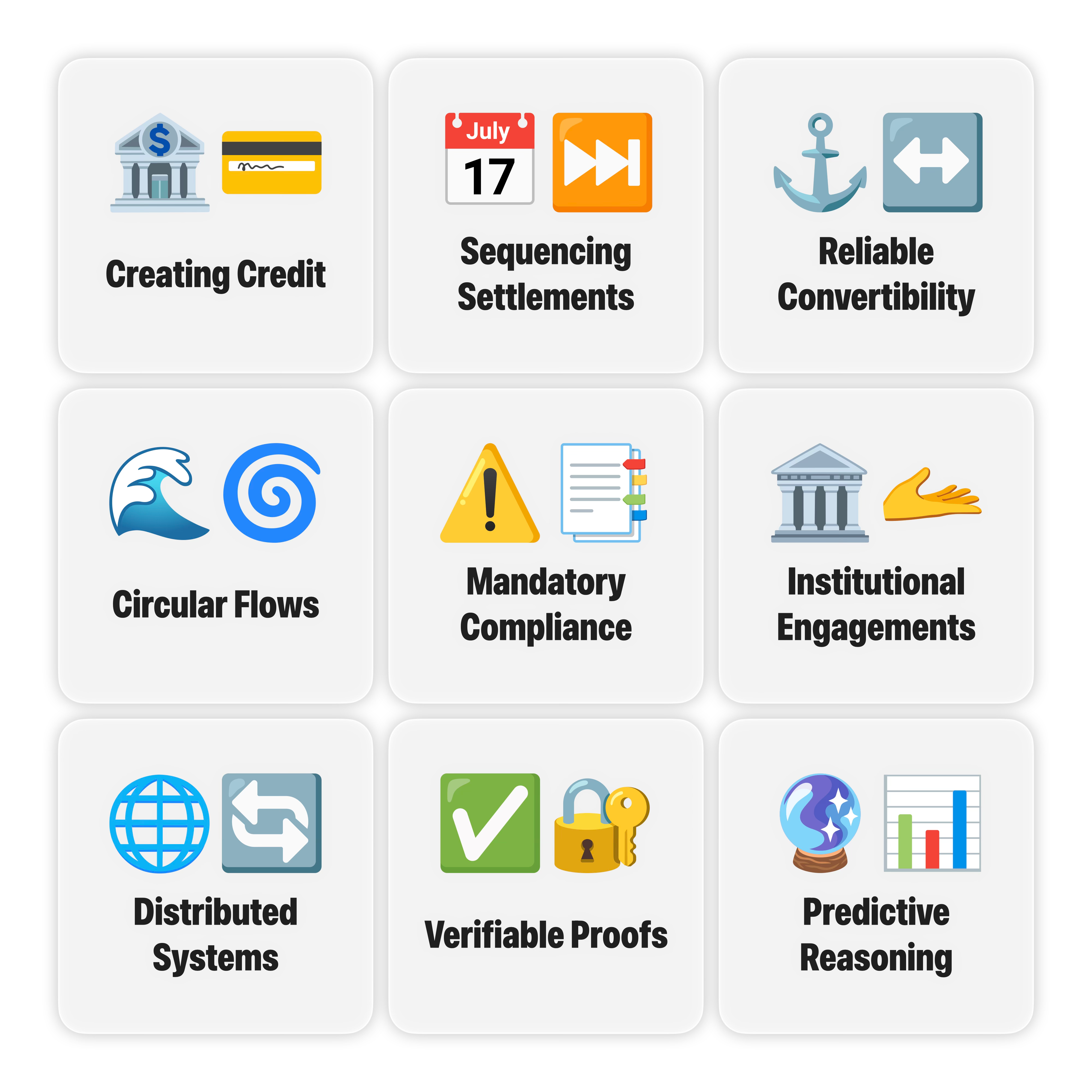
We selected exactly 9 analytical lenses from 90 available across 10 perspectives—Financial Cycles (Creating Credit, Sequencing Settlements), Holistic Metrics (Reliable Convertibility, Circular Flows), Constitutional Governance(Mandatory Compliance, Institutional Engagements), Engineered Infrastructure (Distributed Systems), Multisided Platforms (Verifiable Proofs), and Specific Abilities (Predictive Reasoning). This constraint forces strategic discipline: each lens must illuminate meaningful systemic features rather than superficial description. The minimum three perspectives ensures cross-domain analysis rather than single-discipline silos.
The five architectures examined are: Decentralized Event Markets (Polymarket operating on Polygon with $3.74B peak monthly volume optimizing for censorship resistance, though baseline non-election activity $200-500M and 10-30% volume inflation risk from wash trading), Regulated Prediction Exchanges (Kalshi with CFTC designation achieving $5.8B monthly volume optimizing for institutional legitimacy, though 85% sports concentration), Traditional Financial Forecasting (options-implied volatility and polling aggregates maintaining $100T+ annual volumes optimizing for continuous distributions, though this represents total equity turnover not direct comparison), AI-Enhanced Forecasting Platforms (Drift BET, Pariflow integrating machine learning and yield generation optimizing for capital efficiency, though AI Brier performance ~0.178 vs. top-decile markets 0.0256), and Play-Money Prediction Communities(Manifold Markets using virtual currency optimizing for accessibility, achieving median Brier ~0.21 vs. top-decile real-money 0.0256).
This analysis reveals coexistence: prediction markets occupy a specialized niche for discrete-event probability pricing—achieving exceptional calibration in highly liquid markets—while traditional stock markets continue dominating continuous enterprise valuation and capital allocation. The systems serve non-competing functions: event-specific hedging versus broad economic exposure.
The Three-Function Framework: All forecasting systems must aggregate dispersed information into probability signals, commit capital to make those signals economically binding, and designate authority structures to resolve outcomes. Systems differentiate not by the presence or absence of these functions, but by how they are institutionally bundled. Polymarket combines permissionless information aggregation (order books), crypto capital commitment (collateral), and decentralized resolution authority (on-chain oracles). Kalshi combines regulated information aggregation (approved markets), institutional capital commitment (margin requirements), and regulatory resolution authority (CFTC-certified settlement). Traditional forecasting combines continuous information aggregation (trading), equity capital commitment (ownership), and legal resolution authority (corporate cash flows verified through courts). This framework makes prediction market architecture exportable to insurance markets, derivatives clearing, DAO governance, and reputation markets.
Understanding Brier Scores: Predictive accuracy throughout this report is measured using the Brier score, calculated as the mean squared difference between forecast probabilities and actual outcomes (0 or 1). Lower values indicate better calibration. A perfectly accurate forecast has a Brier score of 0, while random guessing (assigning 0.5 probability to all events) yields 0.25. The exceptional performance cited for Polymarket (0.0256) applies to approximately 15-20% of highly liquid markets under specific conditions (binary outcomes, unambiguous resolution criteria, >$1M volume, measured 12-24 hours before resolution), with median performance across all markets at 0.0581. For comparison: top human superforecasters achieve 0.15-0.20, AI systems approximately 0.178, and play-money markets approximately 0.21.
Brier Score Formula: Brier = Σ(forecast probability − outcome)² / N, where outcome is 0 or 1, and N is the number of forecasts.
This report cites 20 sources (expanded from standard 18 due to contested accuracy claims requiring deeper academic grounding), grouped by analytical lens to show evidential logic. The theoretical commitment is complexity economics (path dependency, increasing returns, layered co-evolution) for diagnostic analysis, not prediction. We use multi-jurisdictional scope reflecting regulatory fragmentation: Polymarket operates globally excluding U.S., Kalshi operates U.S.-nationwide, traditional markets maintain established jurisdictional boundaries.
Research Limitations: This analysis focuses on contemporary platform infrastructure and regulatory positioning. Notable academic literature on prediction market theory and empirical performance—including Wolfers & Zitzewitz (2004) on information aggregation efficiency, Berg et al. (2008) on Iowa Electronic Markets long-run accuracy, Hanson (2007) on market scoring rule design, and Rothschild (2009) on comparative forecasting biases—is integrated where relevant but not exhaustively synthesized. Platform volume figures rely substantially on self-reported data without independent audit, creating potential inflation from wash trading or bot activity (estimated 10-30% for crypto platforms). Brier score claims require careful methodological qualification: exceptional 0.0256 performance applies to approximately 15-20% of highly liquid markets under specific conditions, with median performance across all markets at 0.0581. AI forecasting performance remains exploratory with limited longitudinal validation.
References
References are grouped by analytical lens to show evidential logic.
Creating Credit
Financial Cycles
[1] Polymarket. “Platform Statistics and Volume Data.” Polymarket.com, November 2024.
[Status: Self-Reported; Verified: 2026-02-11]
Insight: Demonstrates that decentralized prediction markets can achieve $3.74 billion in self-reported peak monthly volume through actuarial liquidity creation against statistical event outcomes, though independent blockchain analysis suggests 10-30% may represent wash trading or non-economic activity, with baseline non-election monthly volumes approximating $200-500 million.
[2] Drift Protocol. “Drift BET Launch Announcement.” Drift Protocol Documentation, August 2024.
[Status: Public; Verified: 2026-02-11]
Insight: Illustrates how yield-generating collateral transforms prediction market capital efficiency by enabling simultaneous lending returns and forecasting exposure, creating circular flows unavailable in traditional event betting—though total value locked remains below $100 million, indicating experimental rather than mainstream adoption.
Distributed Systems
Engineered Infrastructure
[3] Polygon Labs. “Polygon PoS Chain Architecture.” Technical Documentation, 2024.
https://polygon.technology/papers
[Status: Public; Verified: 2026-02-11]
Insight: Explains how Layer-2 scaling solutions achieve sub-$0.01 transaction costs and 2-second finality, enabling high-frequency prediction market trading economically infeasible on Ethereum mainnet—critical infrastructure for platforms like Polymarket achieving billions in monthly volume during peak periods.
[4] Solana Foundation. “Solana Architecture Overview.” Solana Documentation, 2024.
[Status: Public; Verified: 2026-02-11]
Insight: Demonstrates 400-millisecond settlement finality creating competitive advantages for real-time event markets where information incorporation speed determines price discovery quality—though network reliability history raises questions about whether speed advantages compensate for outage risks.
Verifiable Proofs
Multisided Platforms
[Shared with: Decentralized Event Markets, Regulated Prediction Exchanges, Play-Money Communities]
[5] UMA Protocol. “Optimistic Oracle Design.” UMA Documentation, 2024.
[Status: Public; Verified: 2026-02-11]
Insight: Shows how bonded challenge mechanisms enable decentralized resolution authority without centralized arbitration, creating censorship resistance through economic incentive alignment rather than institutional trust—used by Polymarket for thousands of market resolutions with documented reliability for objective, verifiable outcomes.
[6] U.S. Commodity Futures Trading Commission. “Designated Contract Market Rulebook.” CFTC.gov, 2024.
[Status: Public; Verified: 2026-02-11]
Insight: Reveals how regulatory certification of resolution procedures provides institutional legitimacy and legal certainty, creating trust through compliance oversight rather than cryptographic guarantees—enabling Kalshi’s clearinghouse integration and institutional partnerships through formalized resolution authority.
[7] Brier.fyi. “Prediction Market Calibration Methodology.” Technical Documentation, 2025.
[Status: Public; Verified: 2026-02-11]
Insight: Independent evaluation framework using proper scoring rules across 10,000+ resolved markets, explaining sample weighting (liquidity-based), outlier exclusion (disputed resolutions), and temporal horizons (12-24 hour measurement windows) that generate aggregate Brier scores—essential methodology for validating platform performance claims and understanding that exceptional 0.0256 calibration applies to approximately 15-20% of highly liquid markets rather than all markets uniformly.
Mandatory Compliance
Constitutional Governance
[8] Kalshi Inc. “CFTC Registration and Compliance Framework.” Company filings, 2021.
[Status: Public; Verified: 2026-02-11]
Insight: Demonstrates that full regulatory registration as designated contract market enables clearinghouse protection and institutional partnerships unavailable to decentralized alternatives, at the cost of innovation constraints from case-by-case contract approval—strategic trade-off between legitimacy and agility.
[9] U.S. Court of Appeals, D.C. Circuit. “Kalshi v. CFTC Decision on Event Contracts.” September 2024.
[Status: Public; Verified: 2026-02-11]
Insight: Establishes political control outcomes as commodities rather than gambling under U.S. law, expanding permissible prediction market scope but leaving regulatory boundaries actively contested—critical legal precedent enabling Kalshi’s political contracts while regulatory uncertainty persists for other event types.
Reliable Convertibility
Holistic Metrics
[Shared with: Regulated Prediction Exchanges, Traditional Financial Forecasting]
[10] Hull, John C. Options, Futures, and Other Derivatives. 11th Edition. Pearson, 2021.
[Status: Public; Verified: 2026-02-11]
Insight: Explains Black-Scholes framework for extracting implied probability distributions from options prices, revealing how traditional markets achieve continuous outcome encoding unavailable in binary prediction contracts—foundational theory enabling comparison between options-implied volatility and prediction market probabilities.
[11] Wolfers, Justin, and Eric Zitzewitz. “Prediction Markets.” Journal of Economic Perspectives 18.2 (2004): 107-126.
[Status: Public; Verified: 2026-02-11]
Insight: Establishes theoretical foundation for information aggregation through market mechanisms, demonstrating that prediction markets can outperform polls when information is dispersed and incentives aligned—seminal academic work providing empirical grounding for claims about prediction market accuracy advantages over traditional forecasting methods in specific contexts.
[12] Kalshi Inc. “Inflation Market Performance Analysis.” Platform documentation, 2025.
[Status: Self-Reported; Verified: 2026-02-11]
Insight: Claims 4.3× lower volatility than Cleveland Fed nowcast model, suggesting regulated prediction markets provide real-time consensus about future inflation enabling anticipatory hedging—though comparative claim requires independent validation through peer-reviewed methodology rather than platform self-report.
Sequencing Settlements
Financial Cycles
[13] Depository Trust & Clearing Corporation. “T+2 Settlement Standard.” DTCC.com, 2024.
[Status: Public; Verified: 2026-02-11]
Insight: Documents two-business-day settlement cycles in traditional equity markets creating counterparty risk and capital inefficiency that blockchain’s instant finality eliminates—with industry migration toward T+1 (completed 2024) representing institutional recognition of settlement speed advantages, though even accelerated traditional clearing remains orders of magnitude slower than blockchain.
[14] Ethereum Foundation. “Proof-of-Stake Consensus Finality.” Ethereum Documentation, 2024.
[Status: Public; Verified: 2026-02-11]
Insight: Explains 12-second block finality on Ethereum creating settlement speed advantages over traditional clearing, though Layer-2 solutions like Polygon achieve further improvements to approximately 2 seconds—critical infrastructure enabling prediction market information incorporation speeds impossible with conventional financial settlement.
Institutional Engagements
Constitutional Governance
[15] U.S. Securities and Exchange Commission. “Regulation Fair Disclosure (Reg FD).” SEC.gov, 2000 (amended 2024).
[Status: Public; Verified: 2026-02-11]
Insight: Establishes mandatory disclosure requirements creating standardized information flows in equity markets, enabling systematic probability updating unavailable when corporate data release is voluntary or strategic—foundational regulatory infrastructure that prediction markets cannot replicate for most event types, supporting coexistence thesis.
[16] American Association for Public Opinion Research. “Best Practices in Polling Methodology.” AAPOR Standards, 2024.
[Status: Public; Verified: 2026-02-11]
Insight: Documents professional standards for polling accuracy creating reputational incentives for methodological transparency, though without regulatory enforcement comparable to SEC oversight of corporate disclosure—illustrating how traditional forecasting methods rely on different governance mechanisms than prediction markets’ financial incentives.
Predictive Reasoning
Specific Abilities
[Shared with: AI-Enhanced Platforms, Play-Money Communities]
[17] Prophet Arena. “AI Forecasting Benchmark Results.” August 2025.
[Status: Public; Verified: 2026-02-11]
Insight: Shows GPT-5 achieving Brier score of approximately 0.178 on live forecasting questions, suggesting AI systems approach human superforecaster performance though remaining well below top-decile prediction market calibration (0.0256)—exploratory benchmarking with limited longitudinal validation indicating AI forecasting remains emerging rather than competitive with frontier human-market performance.
[18] Tetlock, Philip E., and Dan Gardner. Superforecasting: The Art and Science of Prediction. Crown, 2015.
[Status: Archival; Verified: 2026-02-11]
Insight: Establishes that trained human forecasters achieve Brier scores of 0.15-0.20 through systematic probability updating and feedback, providing baseline for comparing prediction market and AI performance—foundational research demonstrating that individual human forecasting can approach but typically not exceed well-functioning market aggregation.
[19] Berg, Joyce, Robert Forsythe, Forrest Nelson, and Thomas Rietz. “Results from a Dozen Years of Election Futures Markets Research.” Handbook of Experimental Economics Results 1 (2008): 742-751.
[Status: Public; Verified: 2026-02-11]
Insight: Provides long-run empirical validation showing Iowa Electronic Markets achieved lower mean absolute error than polls in 596 of 964 election instances across 15 years, supporting accuracy claims while documenting failure modes including susceptibility to coordinated manipulation and overconfidence in certain electoral contexts—critical evidence for coexistence thesis that prediction markets outperform alternatives in specific conditions rather than universally.
[20] Rothschild, David. “Forecasting Elections: Comparing Prediction Markets, Polls, and Their Biases.” Public Opinion Quarterly 73.5 (2009): 895-916.
[Status: Public; Verified: 2026-02-11]
Insight: Comparative analysis showing prediction markets and poll aggregates exhibit different systematic biases (markets overweight motivated traders, polls suffer from non-response), supporting coexistence thesis that methodologies complement rather than substitute—neither forecasting approach universally dominates, with optimal method dependent on information environment and event characteristics.
Circular Flows
Holistic Metrics
[21] Drift Protocol. “Cross-Margin Architecture.” Technical Documentation, 2024.
[Status: Public; Verified: 2026-02-11]
Insight: Demonstrates unified margin accounts enabling simultaneous prediction market positions and perpetual futures exposure, creating capital efficiency through DeFi composability—novel infrastructure combining event forecasting with yield generation, though adoption remains limited with total value locked below $100 million indicating experimental rather than mainstream status.
Additional Sources
The following sources inform the analysis and are referenced in narrative text:
Hanson, Robin. “Logarithmic Market Scoring Rules for Modular Combinatorial Information Aggregation.” Journal of Prediction Markets 1.1 (2007): 3-15. — Referenced in Phenomenon 4 for automated market maker mathematics underlying platforms like Hedgehog.
Camerer, Colin F. “Can Asset Markets Be Manipulated? A Field Experiment with Racetrack Betting.” Journal of Political Economy 106.3 (1998): 457-482. — Referenced in Phenomenon 4 for experimental evidence on market manipulation vulnerability and arbitrage efficiency.